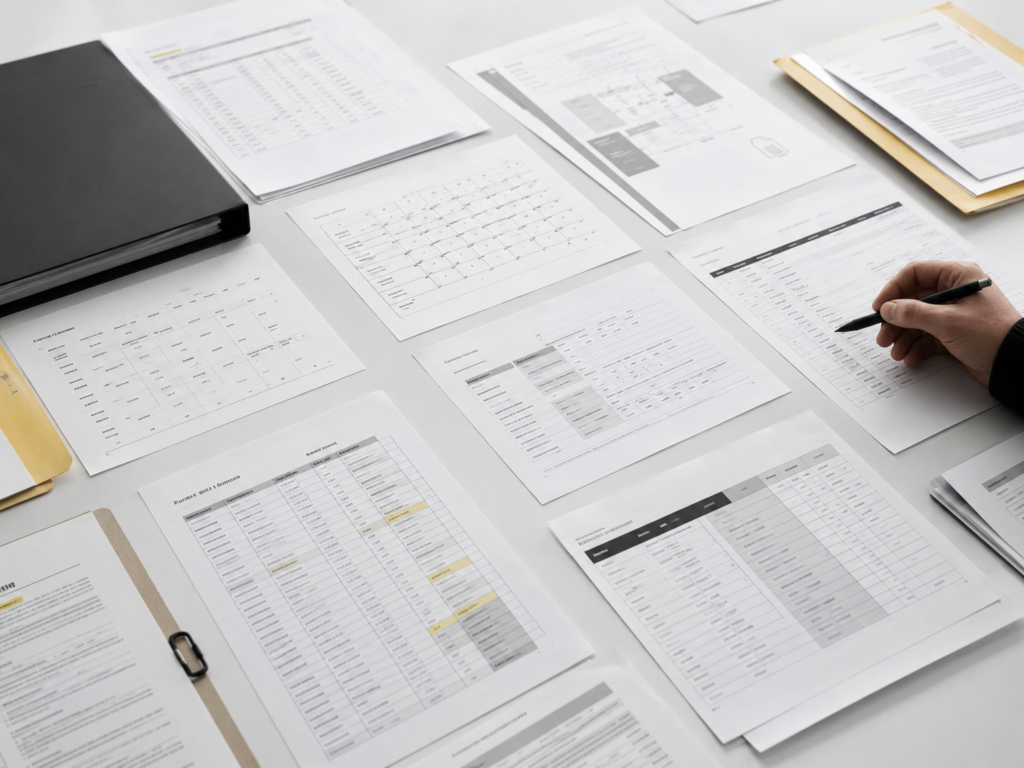
Client records are scattered across spreadsheets, folders, accounting-software exports and email attachments, making every review slower than it should be.
Aeterna recovers, cleans and structures the usable information so an independent accountant can find, compare and prepare client records without repeatedly rebuilding the same work.
THE SITUATION
An independent accountant or small accounting practice may manage information for dozens or hundreds of clients.
Records arrive through spreadsheets, accounting-software exports, email attachments, scanned documents and shared folders. Over time, that information becomes distributed across different file structures, naming conventions and accounting periods.
The information exists, but finding it often requires opening several files, checking different versions and remembering where each detail was stored.
The accountant may spend significant time locating and preparing information before the actual professional review can begin.
WHY IT BECOMES A PROBLEM
Common difficulties include:
- Different spreadsheet structures for each client
- Files stored under inconsistent names
- Duplicate or conflicting records
- Information separated across accounting periods
- Damaged, outdated or unreadable files
- Supporting documents that are difficult to locate
- Sensitive client information requiring controlled access
- Repeated manual comparison between files
As the client base grows, the volume of information becomes increasingly difficult for one person to locate, compare and remember without a more reliable working structure.
Time that should be used for accounting review and professional analysis is instead spent handling files.
WHAT A BETTER PROCESS LOOKS LIKE
Client information is brought together from approved sources and organized around the way the accountant actually works.
The information can be structured around:
- Client
- Accounting period
- Document type
- Transaction
- Review status
- Outstanding exception
Relevant records become easier to find, compare and trace back to their original source.
The accountant spends less time searching through folders and reconstructing information, while retaining full responsibility for accounting interpretation and professional judgment.
THE SYSTEM ORGANIZES THE INFORMATION
THE PROFESSIONAL RETAINS THE JUDGMENT
BEFORE
Folders → Spreadsheets → Emails → Scans → Exports → Manual reconstruction
AFTER
Client → Period → Transaction → Document → Review → Exception



WHAT AETERNA FIXES
Aeterna works directly with the approved files and information involved in the problem.
Depending on the agreed scope, the work may include:
- Recovering usable information from damaged or outdated files
- Cleaning and standardizing fragmented records
- Identifying duplicates, conflicting values and missing information
- Extracting usable information from scanned or image-based documents
- Organizing records by client, period, transaction or review status
- Reconnecting records with their supporting documents
- Preparing information for import, analysis or controlled search
- Separating uncertain information for professional review
- Creating a more consistent working structure for future records
The objective is to leave the accountant with information that is easier to locate, compare and use.

EXPECTED WORKING RESULT
Information previously distributed across spreadsheets, folders, scans and exports becomes part of a more controlled working structure.
Depending on the scope:
- Usable records follow a more consistent format
- Relevant documents are easier to retrieve
- Information remains connected to its original source
- Duplicate and conflicting records become visible
- Damaged or unreadable files remain identified
- Unresolved exceptions are separated for review
- Recurring work requires less manual reconstruction
The result is not an automated accounting decision.
It is better-organized information that allows the accountant to perform professional work more efficiently.
OPERATIONAL VALUE
The practice can reduce time spent:
- Opening files individually
- Searching through folders
- Comparing several versions
- Locating supporting documents
- Reconstructing information manually
- Preparing recurring reviews from the beginning
- Checking the same records repeatedly
Relevant information becomes easier to find, compare and trace.
Uncertain values and unreadable documents remain visible instead of being silently accepted or lost inside an automated process.
WHAT THE BUSINESS RECEIVES
Depending on the agreed scope, the accountant or practice may receive:
- Recovered usable information
- Cleaned and standardized records
- A structured client-information dataset
- Connections between records and original documents
- A visible list of unresolved exceptions
- Import-ready or analysis-ready information
- A private searchable working environment, when required
- Essential instructions for maintaining the structure
Documentation is limited to what is necessary to use, validate and maintain the result.
SCOPE BOUNDARIES
Aeterna does not replace accounting, legal, tax or professional judgment.
The accountant or appropriate specialist remains responsible for confirming:
- Accounting classifications
- Tax treatment
- Ambiguous financial information
- Conflicting values that cannot be resolved from the available records
- Professional conclusions based on the prepared information
Not every damaged file can be recovered reliably.
Confidential information is processed only within the environment and access conditions agreed for the engagement.
Public AI services are not used for confidential client records unless the business has expressly approved the platform and its data-handling conditions.
RELATED SERVICE
DATA QUALITY & INFORMATION STRUCTURING
A hands-on engagement for recovering usable information, cleaning fragmented client records and organizing them into a more reliable working structure.
[DISCUSS A CLIENT DATA PROBLEM →]
