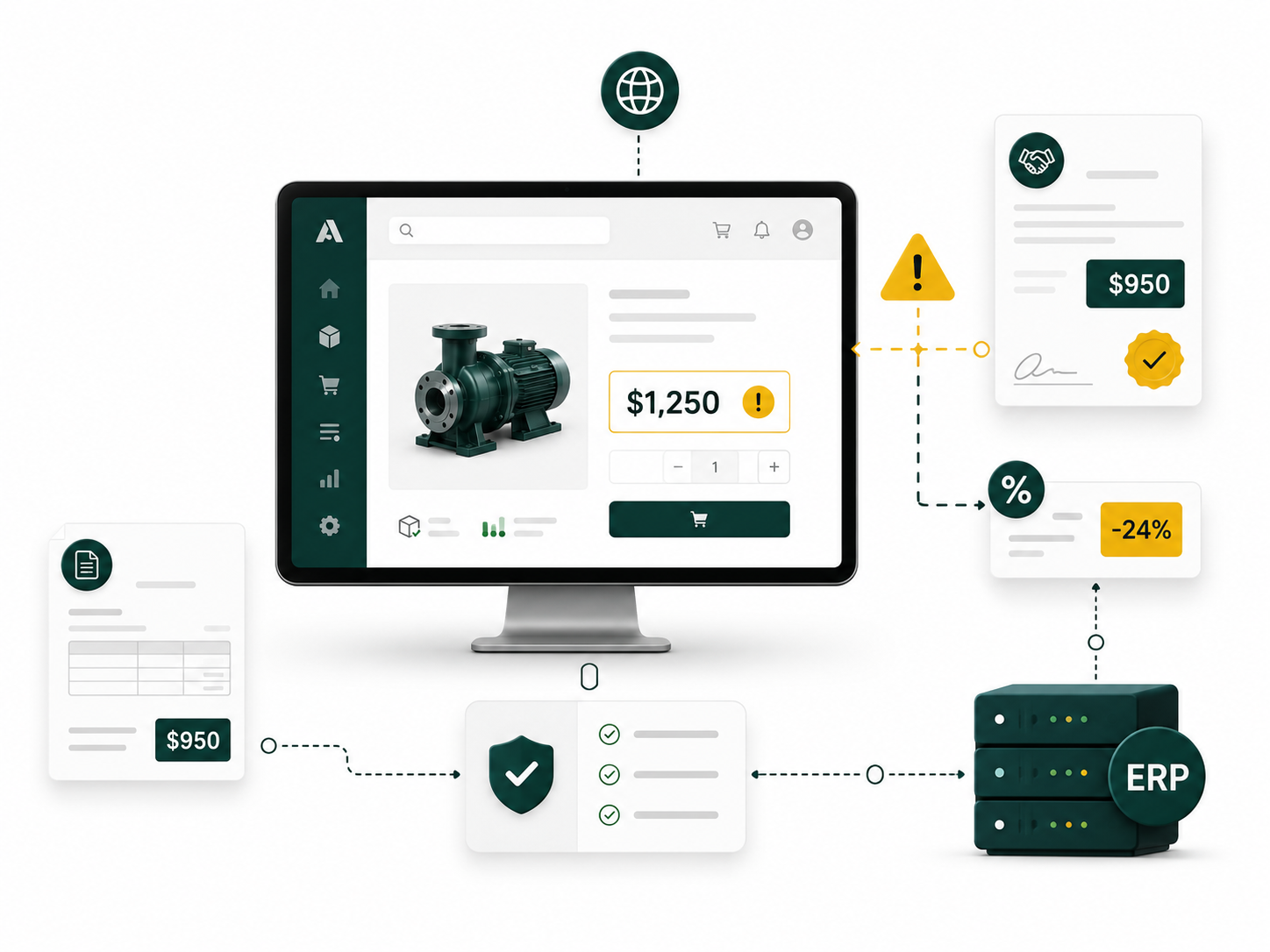
Contract prices, discounts, credit rules and product access may exist inside the ERP without reaching the Contract prices, discounts, product access and credit conditions may already exist inside the ERP without reaching the customer portal correctly.
Aeterna corrects the data, configuration and integration issues that prevent B2B customers from seeing the commercial conditions that apply to their accounts.
THE SITUATION
A manufacturer, wholesaler or distributor launches a B2B customer portal so buyers can search products, place orders and manage their accounts without contacting the sales team for every transaction.
The portal may already be connected to the ERP. Customers can sign in and products appear online, but the information shown does not always reflect the commercial relationship agreed with the business.
Customers may encounter:
- Generic prices instead of negotiated prices
- Outdated or missing discounts
- Products they are not authorised to purchase
- Missing contract items
- Incorrect tax treatment
- Stock that does not reflect the ERP
- Credit conditions that are not applied
- Different prices online and on the final invoice
The portal works technically.
It does not yet reproduce the real commercial conditions of each customer account.
The portal is online.
The commercial rules are still somewhere else.
WHY IT BECOMES A PROBLEM
B2B customers expect the portal to recognise who they are.
A customer with an agreed contract price, product range, payment condition or discount structure should not need to contact a salesperson to confirm information that already exists inside the company.
When the portal displays incorrect or incomplete information, customers may:
- Return to ordering by email or telephone
- Ask sales employees to confirm every price
- Abandon an order
- Challenge the final invoice
- Request manual corrections
- Stop using the self-service portal
- Purchase from another supplier with a clearer process
Internally, employees compensate by checking the ERP, consulting spreadsheets or relying on personal knowledge of individual accounts.
The portal was intended to reduce manual work. Instead, it becomes another system that employees must verify.
A CUSTOMER PORTAL CANNOT CREATE SELF-SERVICE WHEN CUSTOMERS STILL NEED A PERSON TO CONFIRM THE INFORMATION.
COMMON COMPLICATIONS
CONTRACT PRICES DO NOT APPEAR
The customer signs in but still sees the standard catalogue price instead of the agreed commercial price.
DISCOUNTS ARE APPLIED INCORRECTLY
Customer, product and volume discounts may combine differently across the ERP and the portal.
CUSTOMER CATALOGUES ARE INCOMPLETE
Customers may see products they cannot purchase or fail to see contract-specific items.
PRICES CHANGE BETWEEN ORDER AND INVOICE
The portal calculates one value, but the ERP applies different rules when the order is processed.
STOCK CANNOT BE TRUSTED
Online availability does not reflect reservations, warehouse locations or sellable inventory.
CREDIT CONDITIONS REMAIN MANUAL
The portal accepts an order even though the customer’s credit position requires review.
COMMERCIAL KNOWLEDGE LIVES WITH INDIVIDUAL EMPLOYEES
Sales employees understand the exceptions, but the rules are not represented consistently inside the systems.
EVERY CUSTOMER REQUEST BECOMES A CUSTOM FEATURE
One-off changes accumulate until the portal becomes expensive and difficult to maintain.
THE ERP AND PORTAL USE DIFFERENT DEFINITIONS
Customer groups, product categories, prices or discount conditions do not mean the same thing in both systems.
WHAT A BETTER PROCESS LOOKS LIKE
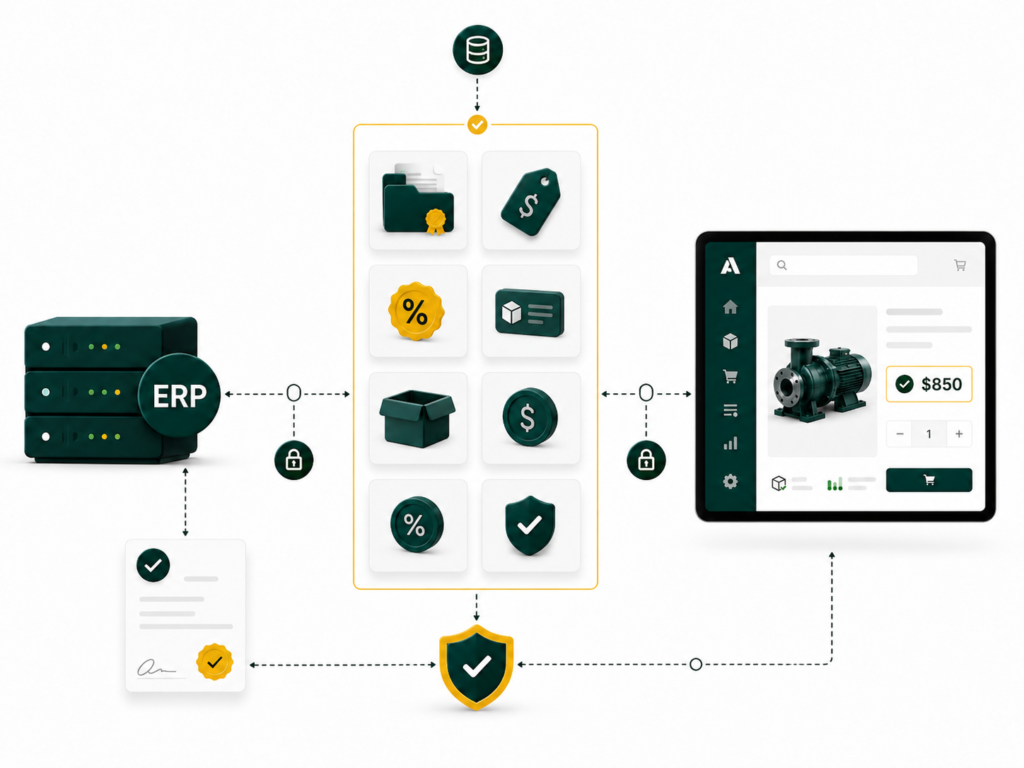
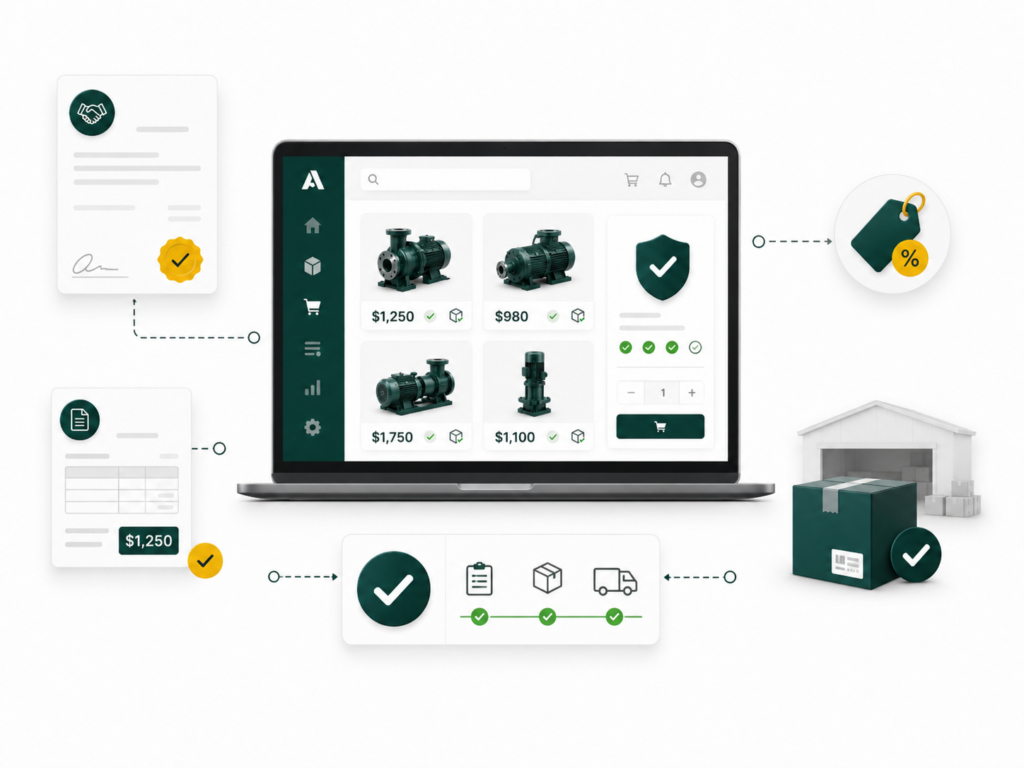
The portal identifies the customer and receives the commercial conditions that genuinely apply to that account.
Depending on the business model, this may include:
- Contract prices
- Customer-specific discounts
- Volume discounts
- Approved product ranges
- Customer-specific catalogues
- Payment conditions
- Credit restrictions
- Tax treatment
- Stock availability
- Delivery conditions
- Previous orders
- Open invoices
- Return conditions
Each important value has a defined source.
The company knows:
- Where contract prices are maintained
- Which system controls discounts
- How customers are grouped
- Which products each account may purchase
- How stock should be displayed
- When credit restrictions require review
- Which conditions can be applied automatically
- Which exceptions require human approval
The portal should not attempt to infer commercial rules.
It should receive approved information from the appropriate system.
WHAT AETERNA FIXES
Aeterna works on the operational layer between the ERP, the customer portal and the teams responsible for commercial information.
Depending on the agreed scope, Aeterna can:
- Clean and validate customer and product records
- Correct customer-group and account mappings
- Align approved prices and discount structures
- Configure supported product-access rules
- Correct preventable inconsistencies between ERP and portal values
- Clarify which system controls each important value
- Group recurring customer conditions into reusable rules
- Separate standard configuration from genuine development requirements
- Improve the handling of credit, pricing and product-access exceptions
- Test representative customer accounts and orders
- Correct and retest affected configurations or records
- Coordinate integration or custom-development changes with the existing technical provider
The objective is not to deliver an assessment describing why the portal is unreliable.
The objective is to correct the operational rules and data flow so customers receive more accurate information and employees perform fewer manual checks.
EXPECTED WORKING RESULT
Depending on the scope:
- Customers see prices and discounts associated with the correct account
- Approved product access is applied more consistently
- Stock information follows defined availability rules
- Orders reach the ERP with fewer preventable discrepancies
- Portal prices align more closely with final order and invoice values
- Credit or approval exceptions become visible
- Reusable customer conditions replace avoidable one-off customisation
- Employees perform fewer manual confirmations
The portal becomes a more reliable extension of the existing commercial process rather than a separate catalogue requiring constant verification.
OPERATIONAL VALUE
MORE RELIABLE CUSTOMER PRICING
Customers see prices and discounts based on approved commercial conditions rather than generic or outdated values.
GREATER PORTAL ADOPTION
Customers are more likely to use self-service when they trust the information displayed.
FEWER MANUAL CONFIRMATIONS
Sales and customer-service employees spend less time verifying prices, stock and account conditions.
FEWER ORDER AND INVOICE DISPUTES
The value shown during ordering is more closely aligned with the rules used by the ERP and invoicing process.
CONTROLLED PERSONALISATION
Recurring customer needs become reusable configurations instead of isolated custom-development requests.
CLEARER RESPONSIBILITY
The company knows who maintains prices, customer groups, product access and approval rules.
A MORE MAINTAINABLE SOFTWARE ENVIRONMENT
The core ERP remains stable while approved commercial information reaches the portal through clearer data, configuration and integration rules.
WHAT THE BUSINESS RECEIVES
Depending on the agreed engagement, the business may receive:
- Corrected customer and product records
- Configured customer groups or account rules
- Validated pricing and discount mappings
- Improved product-access conditions
- Defined ownership of important commercial values
- Results from representative customer and ordering tests
- A visible list of unresolved exceptions
- Corrected and retested affected records or configurations
- Essential instructions for maintaining the working solution
Documentation is limited to what is necessary to validate, maintain and transfer the corrected process.
SCOPE BOUNDARIES
Aeterna works on the data, workflow, configuration and operational integration surrounding the existing ERP and B2B portal.
The company remains responsible for confirming:
- Contractual prices
- Commercial discount conditions
- Credit decisions
- Customer classifications
- Tax and accounting treatment
- Product-access policies
- Exceptions requiring commercial judgment
The existing ERP, portal or implementation partner remains responsible for:
- Extensive custom development
- Core platform extensions
- Infrastructure
- Cybersecurity
- Platform-specific work requiring certified expertise
Aeterna does not replace the company’s legal, tax, accounting or technical specialists.
Critical changes are performed only with appropriate backups, access and testing procedures.
RELATED SERVICE
B2B PORTAL & COMMERCIAL DATA FLOW
A hands-on engagement for correcting customer-specific pricing, discounts, product access, stock information and approval rules between an ERP and a B2B customer portal.
Suitable for:
- Manufacturers
- Wholesalers
- Distributors
- Automotive-parts businesses
- ERP-connected customer portals
- Companies whose customers still order by telephone or email
- Businesses experiencing price differences between portal and invoice
- Companies expanding or replacing a B2B portal
- Implementation partners requiring operational support
[DISCUSS YOUR B2B PORTAL PROBLEM →]
RELATED USE CASE
Are stock, prices, variants or orders failing to synchronize between Business Central and Shopify?
