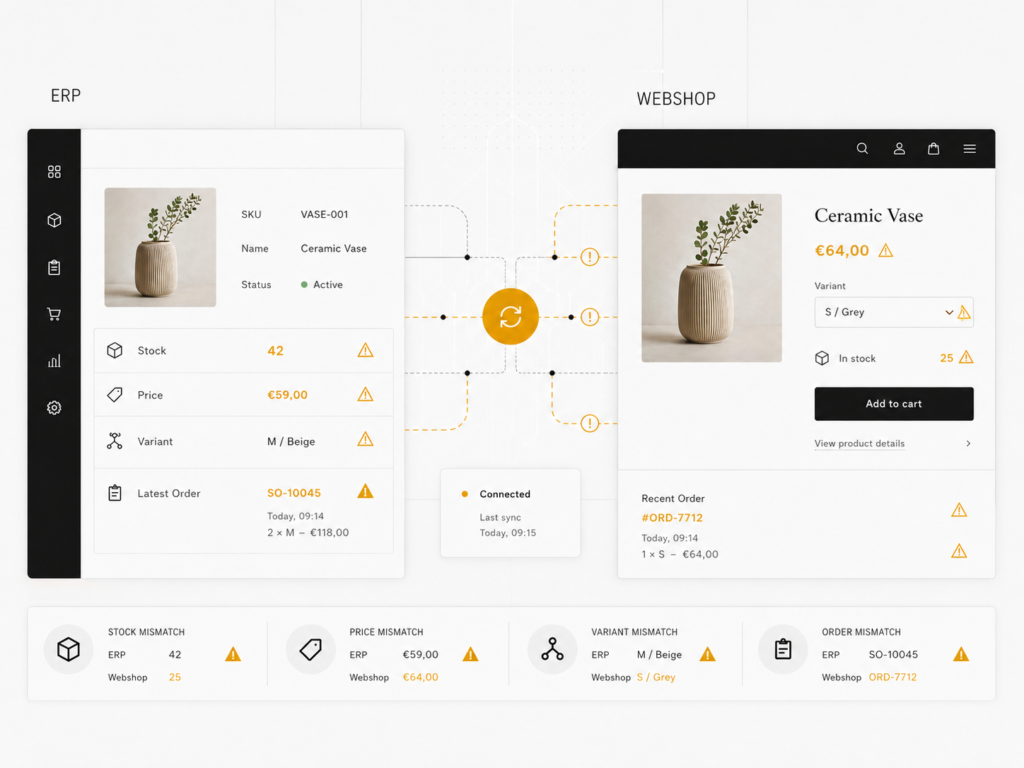
Products may already be connected between Business Central and Shopify while stock, prices, variants or orders still fail to update correctly.
Aeterna corrects the data, mappings and operational rules behind recurring synchronization problems, tests the changes and helps stabilize the existing connection.
THE SITUATION
A company uses Microsoft Dynamics 365 Business Central to manage products, inventory, pricing and orders, while Shopify provides the customer-facing webshop.
The two platforms have already been connected. Products may appear online and orders may reach the ERP, but parts of the information still do not move reliably.
The company may notice that:
- Shopify shows outdated stock levels
- Prices do not reflect current ERP values
- Inventory is retrieved from the wrong item or location
- Product variants are linked incorrectly
- Orders arrive with incomplete or mismatched information
- Changes made in Business Central do not appear online
- Employees repeatedly compare and correct both systems
The systems are connected.
The information is still not reaching the correct records consistently.
WHY IT BECOMES A PROBLEM
A partial synchronization failure can be harder to detect than a complete outage.
When the entire connection stops, the problem is visible. When only certain products, fields or updates fail, incorrect information may remain online without immediate warning.
This can lead to:
- Customers ordering products that are unavailable
- Available products appearing out of stock
- Incorrect prices being published
- Variants being assigned to the wrong product
- Orders requiring manual correction
- Customer service checking stock or prices before confirming orders
- Employees reconciling the same discrepancies repeatedly
- Reports showing different values depending on the system
The issue affects more than the technical connector. It affects customer trust, order processing, inventory planning and internal workload. order processing, inventory planning and internal workload.
A CONNECTED SYSTEM IS NOT RELIABLE UNTIL THE INFORMATION RECONCILES.
COMMON CAUSES
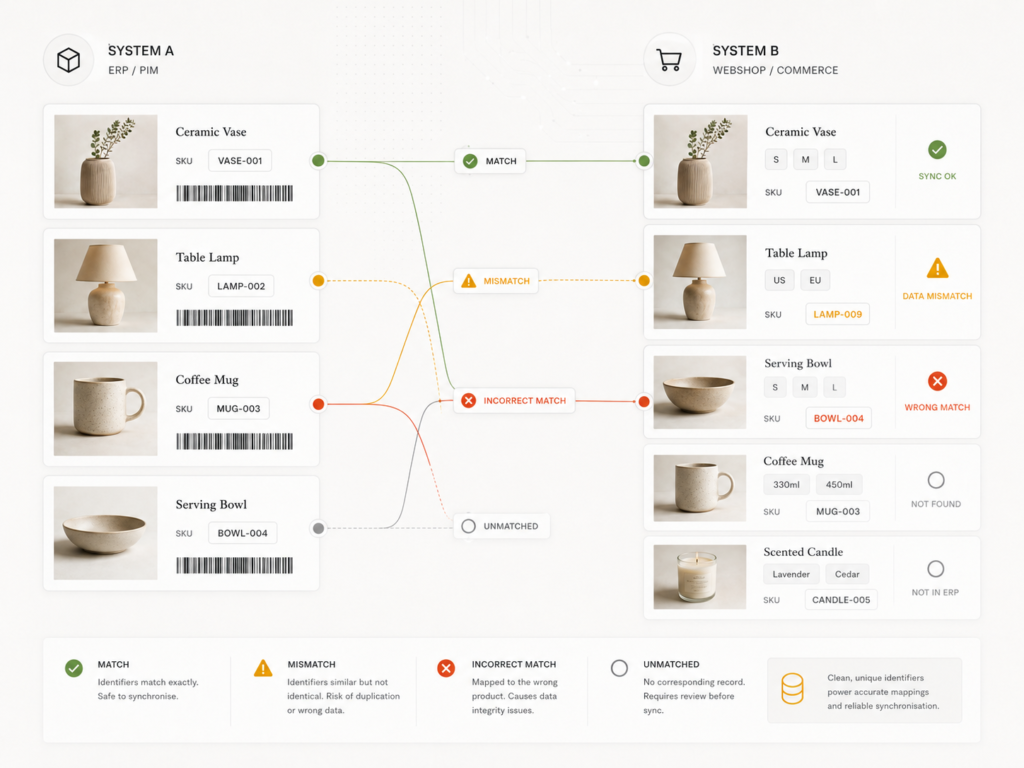
PRODUCT IDENTIFIERS DO NOT MATCH
The Shopify SKU does not consistently correspond with the Business Central item number or variant record.
IDENTIFIERS ARE DUPLICATED OR AMBIGUOUS
Several products or variants use the same reference, preventing the connector from identifying the correct record.
VARIANTS USE DIFFERENT STRUCTURES
One Shopify product with several variants may correspond to separate item records inside Business Central.
THE WRONG INVENTORY LOCATION IS USED
Business Central may hold stock across several locations while Shopify expects one available online quantity.
PRICING RULES DO NOT TRANSLATE CORRECTLY
Price lists, customer groups, discounts, currencies or tax rules may not correspond directly with Shopify’s pricing structure.
SYNCHRONIZATION RUNS IN THE WRONG DIRECTION
A value maintained in Business Central may be overwritten by Shopify, or a webshop value may incorrectly become the internal reference.
UPDATES ARRIVE TOO LATE
The synchronization schedule may not reflect how quickly stock or prices change.
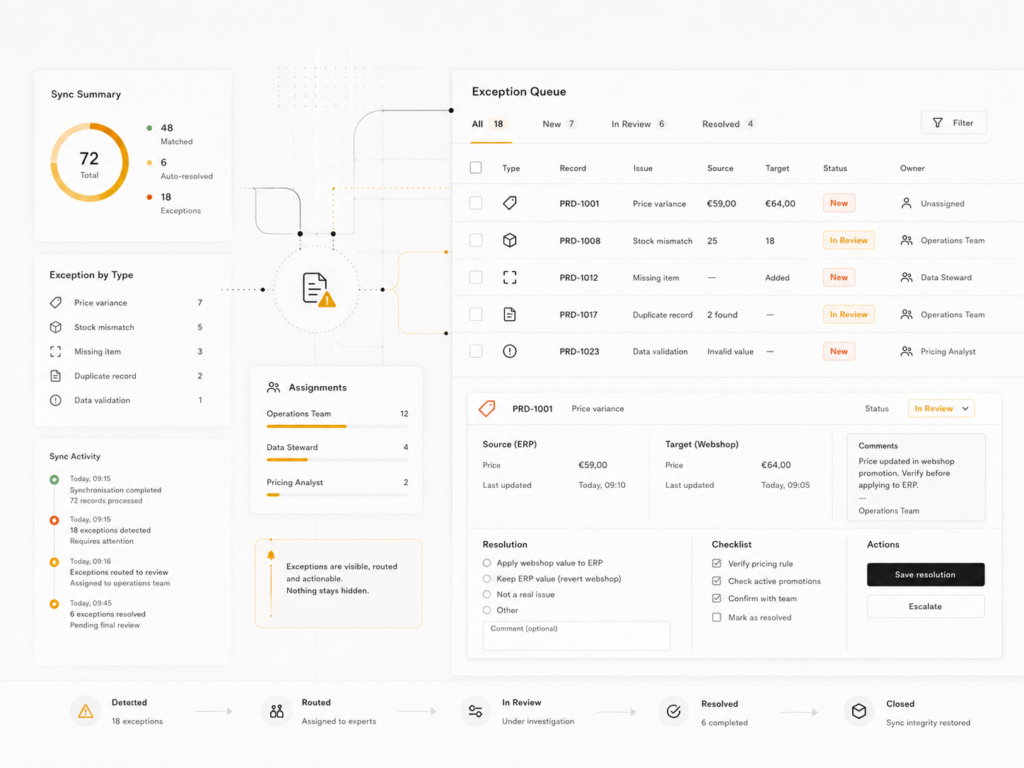
FAILED UPDATES REMAIN HIDDEN
Some records fail while the rest of the synchronization continues, leaving the company without a clear view of what requires correction.
WHAT A BETTER PROCESS LOOKS LIKE
Each important value has a clearly defined source.
The company knows:
- Which system controls product information
- Which system controls online inventory
- Where prices are maintained
- Which identifier connects the same product across both platforms
- How variants are represented
- Which inventory locations contribute to online availability
- When synchronization should occur
- What happens when a record cannot be matched
- Who reviews failed or conflicting updates
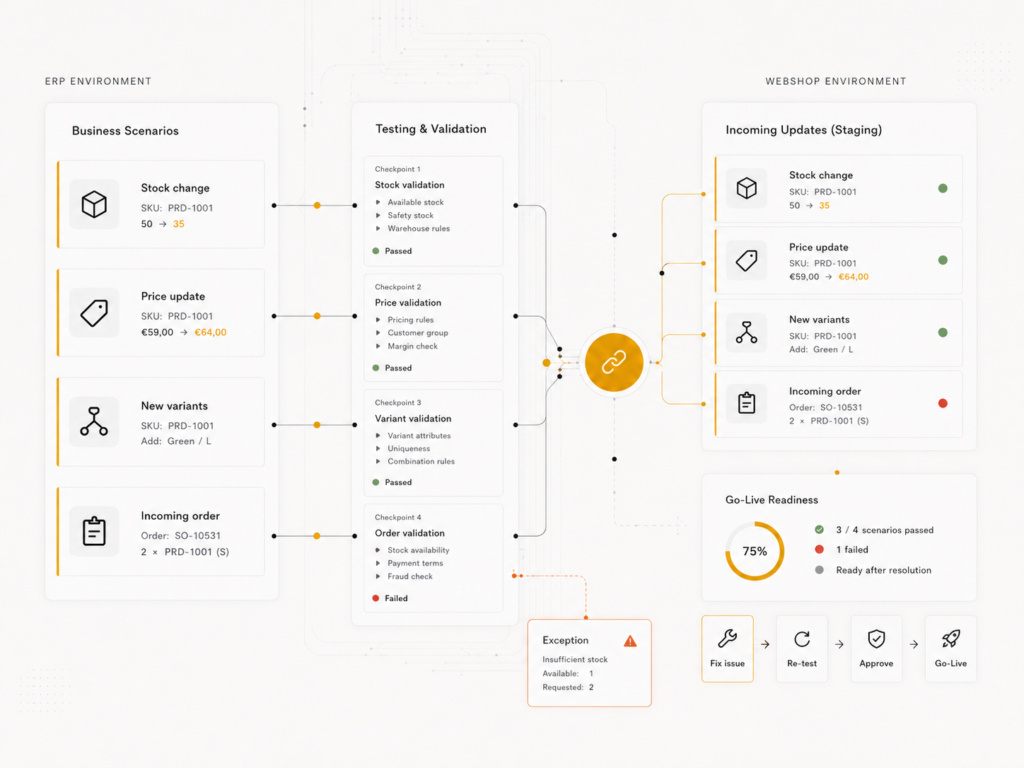
The connection is tested with real business situations rather than only confirming that information can technically pass between the platforms.
For example:
- A stock change reaches the correct Shopify product
- A price update reaches the correct variant
- An online order affects the intended Business Central item and location
- A cancelled or returned order follows the expected process
- A failed update becomes visible
- The same record can be traced across both systems
The objective is not simply to move data.
The objective is to move the right information to the right record.
WHAT AETERNA FIXES
Aeterna works with the company and its existing implementation or connector partner to identify where the mismatch begins and correct the parts that can be improved within the agreed scope.
Depending on the problem, Aeterna can:
- Clean and validate product identifiers
- Correct approved product and variant mappings
- Resolve preventable duplicate or ambiguous references
- Align inventory-location rules with online availability
- Clarify which system owns each important value
- Correct configurable synchronization rules
- Improve the handling of unmatched products and failed updates
- Test stock, price, variant and order scenarios
- Compare expected and actual values across both systems
- Correct and retest affected records
- Coordinate connector or development changes with the technical provider
The objective is not to deliver a report describing the integration problem.
The objective is to correct the operational data flow where possible and leave synchronization failures easier to detect and resolve.
EXPECTED WORKING RESULT
Depending on the agreed scope:
- Products and variants are matched more consistently
- Stock is retrieved from the intended records and locations
- Price updates follow clearer ownership rules
- Orders reach Business Central with fewer preventable mismatches
- Failed updates become visible
- Employees perform fewer repeated corrections
- The company and its implementation partner have a clearer basis for maintaining the connection
The result is not merely an active connector.
It is a more reliable flow of product, inventory, pricing and order information between the systems.
OPERATIONAL VALUE
MORE RELIABLE ONLINE STOCK
Customers see availability based on the intended Business Central records and inventory rules.
FEWER PRICING ERRORS
The value shown online follows a clearer path from its approved source.
STRONGER PRODUCT MATCHING
Products and variants are connected through more reliable identifiers.
FEWER MANUAL CORRECTIONS
Employees spend less time comparing systems and repairing preventable mismatches.
VISIBLE SYNCHRONIZATION FAILURES
Failed or incomplete updates become easier to identify and assign.
CLEARER RESPONSIBILITIES
The company, implementation partner and internal teams understand which party owns the data, the connector and the business decisions.
GREATER CUSTOMER TRUST
Customers are less likely to encounter incorrect availability, unexpected price differences or order corrections caused by inconsistent system data.
WHAT THE BUSINESS RECEIVES
Depending on the engagement, the business may receive:
- Corrected product and variant records
- Validated identifiers and mappings
- Configured synchronization rules where supported
- Defined inventory and pricing ownership
- Results from representative business tests
- A visible list of unresolved exceptions
- Corrected and retested affected records
- Essential operating instructions for reviewing future failures
Documentation is limited to what is necessary to validate, maintain and transfer the working solution.
SCOPE BOUNDARIES
Aeterna works on the operational data, mappings, workflow and configurable rules surrounding the existing connection.
The company remains responsible for confirming:
- Commercial pricing rules
- Inventory-availability decisions
- Product and variant ownership
- Customer-specific conditions
- Ambiguous product matches
- Exceptions that require business judgment
The existing Business Central, Shopify or connector specialist remains responsible for:
- Custom connector development
- Platform-specific extensions
- Infrastructure
- Security configuration
- Changes requiring certified implementation expertise
Aeterna does not claim to replace a Business Central or Shopify implementation partner.
Critical changes are carried out only with appropriate backups, access and testing procedures.
RELATED SERVICE
SYSTEM INTEGRATION & DATA FLOW
A hands-on engagement for correcting product mappings, synchronization rules, failed updates and operational data mismatches between existing business systems.
Suitable for:
- Business Central and Shopify environments
- Stock mismatches between ERP and webshop
- Incorrect or outdated online prices
- Product and variant mapping problems
- Orders requiring repeated manual correction
- Companies expanding their online catalogue
- Implementation partners requiring operational data support
[DISCUSS YOUR BUSINESS CENTRAL–SHOPIFY SYNC →]
RELATED PLATFORMS
The same operational problem can appear between other ERP, webshop and marketplace combinations, including:
- Business Central and WooCommerce
- Odoo and Shopify
- Odoo and WooCommerce
- SAP and B2B portals
- ERP systems and marketplace platforms
Each combination requires separate validation of its identifiers, data ownership, configurable rules and connector behaviour.
